
Beyond Single Functions: How Bacillus aryabhattai Becomes an "Invisible Hub" in Agricultural Microbial Networks
In the crowded market of agricultural biostimulants, most microbes promise a single function: nitrogen fixation, phosphate solubilization, or disease suppression. Bacillus aryabhattai is different—it doesn't settle for a solo performance. Instead, it quietly rewires the collaborative logic of the entire belowground ecosystem.
If you're looking for a microbe that connects multiple functions, here are the roles that genuinely deserve attention.
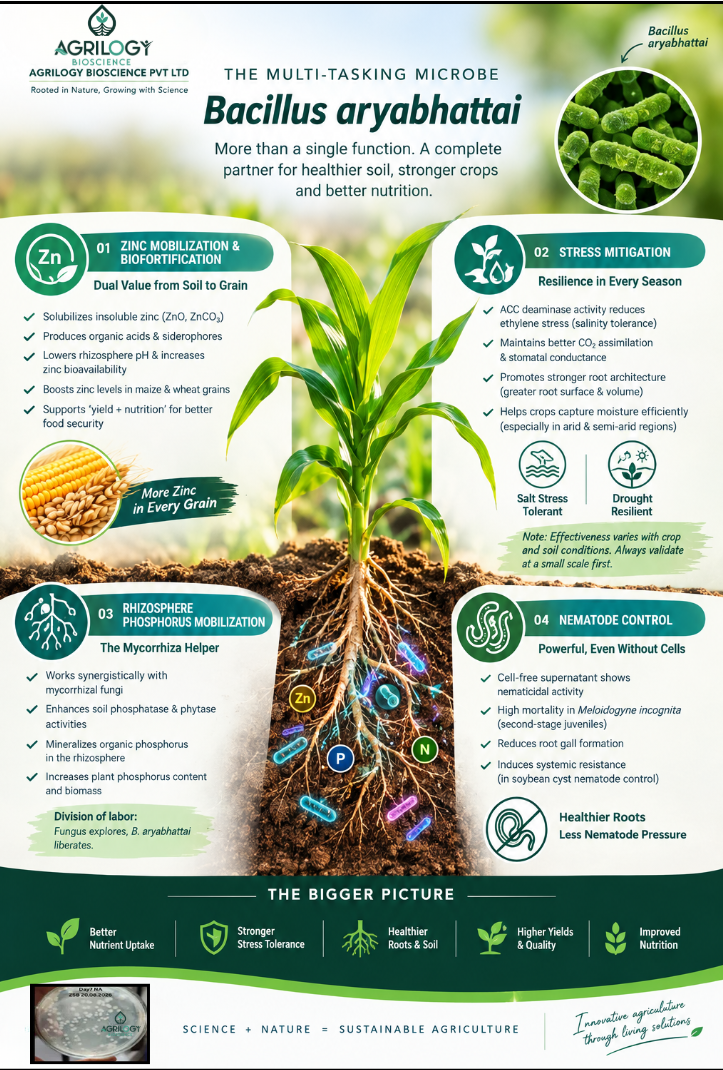
Zinc Mobilization and Biofortification: Dual Value from Soil to Grain
Zinc deficiency is one of the most widespread micronutrient problems globally, particularly in regions where cereal-based diets dominate. B. aryabhattai's performance in zinc mobilization is one of its most practically valuable labels.
Research confirms that this bacterium can solubilize insoluble zinc compounds in soil (such as zinc oxide and zinc carbonate), converting unavailable zinc into plant-accessible forms. During zinc solubilization, organic acids and siderophores produced by the strain work synergistically, lowering rhizosphere soil pH and shifting zinc from organic and carbonate-bound fractions toward exchangeable and oxide-bound forms, thereby increasing zinc bioavailability.
This process delivers more than yield improvement. Field trials show that after inoculation with B. aryabhattai, zinc concentrations in maize and wheat grains increase significantly, achieving a "yield + nutrition" dual benefit. For growers and consumers concerned about food nutritional quality, this biofortification function has direct public health significance.
Stress Mitigation: Crop Performance Under Saline and Drought Conditions
Abiotic stress is a core bottleneck limiting agricultural production, and B. aryabhattai has demonstrated quantifiable effects in mitigating salt and water stress.
Under saline conditions, the bacterium reduces ethylene precursor concentrations in plants through ACC deaminase activity, thereby alleviating salt-induced inhibition of root growth. Maize trials show that after inoculation with B. aryabhattai, plants maintain better gas exchange efficiency even when irrigated with higher-salinity water, with improvements in both CO₂ assimilation rate and stomatal conductance.
In terms of water stress, the root architecture changes promoted by this bacterium—greater root surface area and root volume—enable crops to capture soil moisture more efficiently under limited water conditions. This mechanism is particularly valuable in arid and semi-arid regions.
It is worth noting that this stress mitigation effect is dependent on crop and soil conditions. Under specific circumstances, effects may be limited, which suggests that growers should conduct small-scale validation rather than blindly applying at large scale.
Rhizosphere Phosphorus Mobilization: Synergistic Effects with Mycorrhizal Fungi
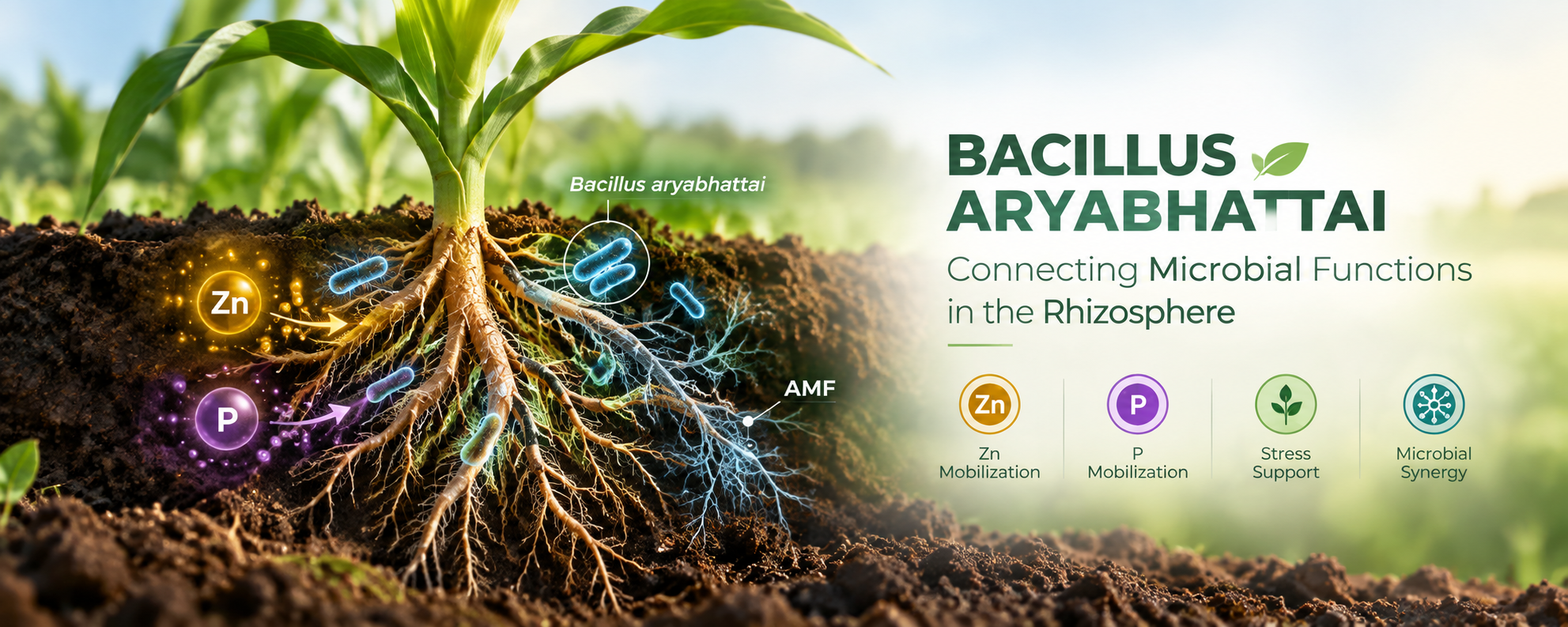
The value of B. aryabhattai as a phosphate-solubilizing bacterium lies not only in its independent action but also in its role as a "mycorrhiza helper bacterium."
A study on Camellia oleifera used a three-compartment cultivation system, separating phosphate-solubilizing bacteria from arbuscular mycorrhizal fungi in different zones to exclude plant root interference and directly observe microbial interactions. Results showed that co-inoculation of B. aryabhattai with mycorrhizal fungi significantly increased plant phosphorus content and biomass, with the mechanism linked to enhanced soil phosphatase and phytase activities in the hyphosphere.
In soils rich in organic phosphorus, this synergistic effect is particularly critical. The mycorrhizal fungal hyphal network expands the range of phosphorus acquisition, while B. aryabhattai mineralizes organic phosphorus in the hyphosphere, releasing phosphorus forms that neither the plant nor the fungus could access alone. This is a classic "division of labor" model, which also explains why this bacterium often performs better in composite inoculation systems.
Nematode Control: Biological Control Effective Even with Cell-Free Supernatant
Plant-parasitic nematodes are invisible killers of many crops, and B. aryabhattai has demonstrated a noteworthy characteristic in this area: its cell-free supernatant also possesses nematicidal activity.
Tomato studies show that both the bacterial suspension and cell-free supernatant of B. aryabhattai cause high mortality in second-stage juveniles of the southern root-knot nematode (Meloidogyne incognita) and reduce root gall formation. This means the nematicidal effect of this bacterium originates at least partially from extracellular metabolites secreted into the environment, rather than relying solely on live bacterial colonization.
In soybean cyst nematode control, B. aryabhattai strains have been confirmed to induce systemic resistance in soybean, upregulating PR protein genes and salicylic acid/jasmonic acid signaling pathway-related gene expression, thereby inhibiting nematode infection. This "induced resistance" mechanism, combined with direct nematicidal activity, constitutes a multi-layered control strategy.
The Practical Significance of Network-Type Microbes
The value of B. aryabhattai lies in the role it plays—a "network node" capable of functioning across multiple ecological niches. It can independently accomplish nutrient transformation tasks such as zinc solubilization and phosphorus mobilization, amplify these effects through synergistic interactions with mycorrhizal fungi, and provide buffering for crops under stress conditions.
For growers, the practical advice is straightforward: view B. aryabhattai as part of a composite microbial strategy rather than expecting a single strain to solve all problems. Strain specificity, crop species, and soil background all significantly influence final outcomes, and small-scale field validation should always be the first step toward rational application.
For agricultural systems, B. aryabhattai represents a different paradigm for microbial utilization: not searching for a "super microbe," but understanding how microbes collaborate with each other, how they communicate with plants, and how they collectively build a resilient rhizosphere ecosystem. In this sense, the most valuable microbe may not be the one that shouts the loudest, but the one that makes the entire system run more smoothly.