
- Home
- Cold pressed vs Azadiractin enriched neem oil
Transform Your Garden into a Personal Paradise!

Neem Oil in Pest Management: Biological Mechanisms, Efficacy, and Safety Profile
Neem oil is one of the most scientifically proven and widely accepted biological pest management tools in sustainable and organic agriculture. Extracted from the seeds of Azadirachta indica, neem oil controls insect pests and certain plant pathogens through biological, hormonal, and behavioral mechanisms, rather than acute chemical toxicity.
At the heart of neem oil’s biopesticidal action lies Azadirachtin, a powerful limonoid that functions as a biological regulator, making neem oil highly effective against pests while remaining remarkably safe for humans, animals, beneficial insects, and the environment.
Neem Oil in Modern Integrated Pest Management (IPM)
In Integrated Pest Management systems, neem oil is classified as a botanical biopesticide. Unlike synthetic pesticides that act as nerve poisons, neem oil interferes with multiple critical life processes of insects:
- Feeding behavior
- Growth and molting
- Reproduction and population buildup
- Host selection and colonization
This multi-target action makes neem oil an ideal tool for resistance-safe and eco-friendly pest control.
Active Compounds in Neem Oil Responsible for Pest Control
Neem oil is a natural consortium of bioactive limonoids, each contributing to pest suppression.
Key Bioactive Components
- Azadirachtin – insect growth regulator, antifeedant, reproductive suppressant
- Salannin & Meliantriol – strong feeding and oviposition deterrents
- Nimbin & Nimbidin – antifungal and antibacterial agents
- Minor limonoids – enhance systemic and behavioral effects
Among these, azadirachtin is the most critical and extensively researched compound.
Azadirachtin: The Biology-Driven Advantage of Neem Oil
Azadirachtin does not act as a neurotoxin. Instead, it targets insect-specific hormonal and physiological pathways, making it highly selective.
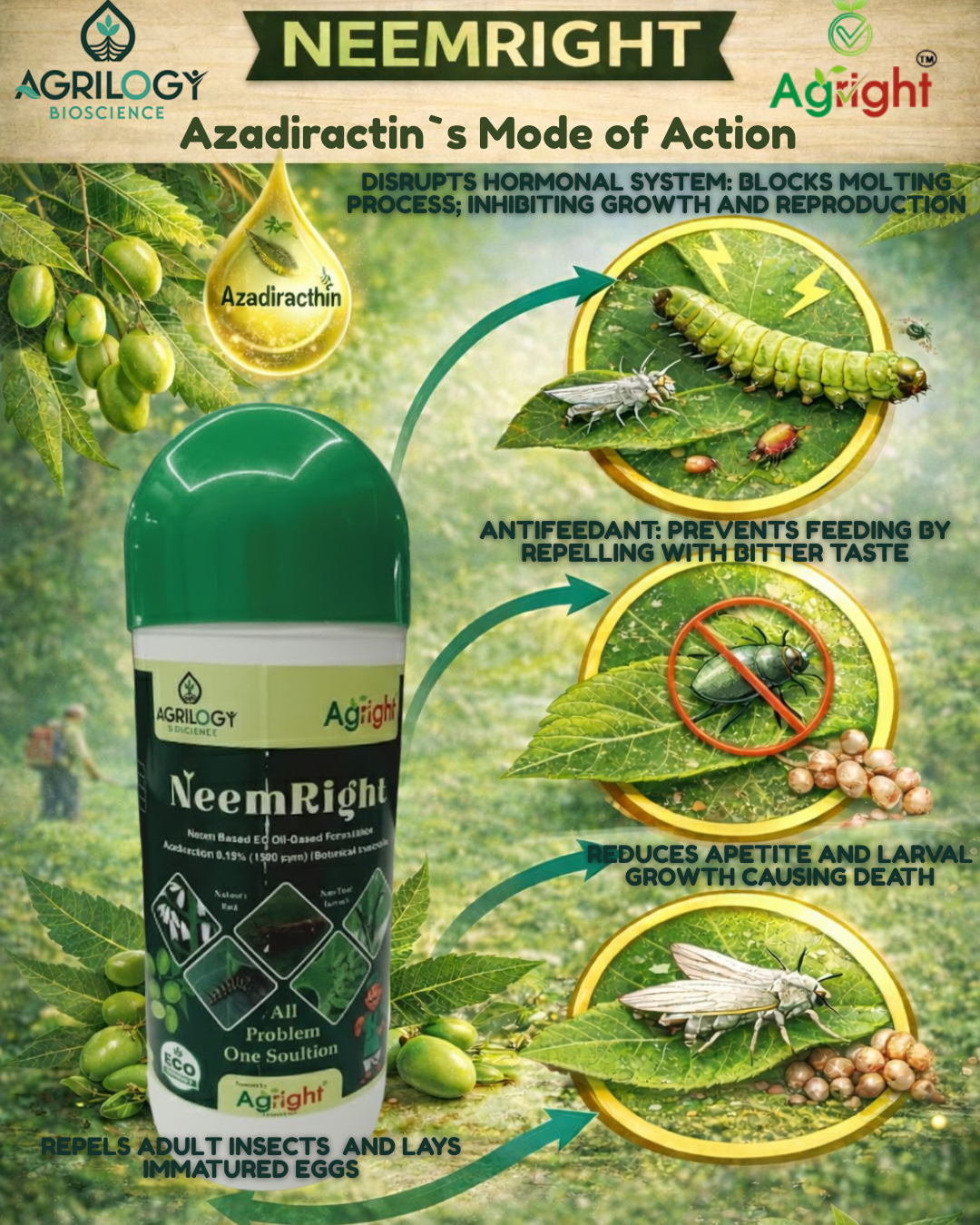
1. Azadirachtin as an Insect Growth Regulator (IGR)
In insects, growth and development are regulated by ecdysone, the molting hormone.
Azadirachtin:
- Inhibits synthesis and release of ecdysone
- Binds to ecdysone receptors without proper activation
- Disrupts hormonal signaling required for molting
Result:
- Larvae fail to molt properly
- Pupation becomes incomplete or abnormal
- Insects die during molting or emerge malformed and non-viable
Key scientific insight:
Mammals do not possess an ecdysone-based molting system, which explains neem oil’s low mammalian toxicity.
2. Antifeedant Action: Immediate Reduction in Crop Damage
Azadirachtin and salannin bind to gustatory receptors in insect mouthparts.
- Treated plants become unpalatable
- Insects stop feeding within hours
- Starvation leads to weakening and eventual death
This explains why neem oil reduces crop damage quickly, even though it is slow-acting in terms of mortality.
3. Reproductive Suppression and Oviposition Deterrence
Azadirachtin controls pests at the population level.
- Inhibits vitellogenesis (egg yolk formation)
- Reduces egg viability and fertility
- Suppresses sperm production in males
- Females avoid laying eggs on neem-treated surfaces
Field implication:
Even surviving insects fail to produce the next generation.
4. Behavioral and Repellent Effects
Neem oil alters insect behavior rather than killing instantly.
- Repels insects from treated crops
- Disrupts mating and pheromone communication
- Reduces pest colonization pressure
5. Direct Physiological Toxicity at Higher Exposure
With repeated exposure or higher concentrations:
- Neem compounds damage insect midgut epithelial cells
- Digestive enzyme activity is inhibited
- Nutrient absorption and energy production decline
This leads to gradual but irreversible mortality.
Efficacy of Neem Oil in Pest and Disease Management
Neem oil is effective against more than 600 insect species, including:
- Aphids
- Whiteflies
- Thrips
- Caterpillars
- Leaf miners
- Beetles
- Mites
Antifungal Activity
Neem oil also suppresses plant fungal diseases:
- Inhibits spore germination
- Disrupts fungal cell wall and membrane integrity
- Induces Systemic Acquired Resistance (SAR) in plants
Safety Profile of Neem Oil: Why It Is Safe for Humans and Mammals
Neem oil’s safety is based on biological selectivity, not dilution.
Neem oil is safe for mammals because it targets biological systems that are unique to insects and fungi. Azadirachtin disrupts the insect molting hormone ecdysone, a system that does not exist in mammals. It also affects chitin-based structures, which form the insect exoskeleton and fungal cell walls, but are completely absent in mammalian tissues. Additionally, mammals possess a highly efficient liver detoxification system that rapidly metabolizes neem compounds, whereas insects have limited detoxification capacity. This absence of target sites combined with rapid metabolic clearance explains neem oil’s high efficacy against pests and its low toxicity to humans and animals.
How Neem Oil Formulation Influences Efficacy and Safety?
While the biological activity of neem oil is driven primarily by azadirachtin, it is important to understand that not all neem oil products are the same. The concentration of azadirachtin, the presence of other limonoids, and the method of processing significantly influence field performance, spectrum of activity, stability, and resistance risk. Commercial neem-based products generally fall into two broad categories—cold-pressed (unrefined) neem oil and azadirachtin-extracted or enriched formulations. Understanding the fundamental differences between these two forms is essential for selecting the most effective and sustainable option for pest management.
Cold-Pressed Neem Oil (Unrefined)
Cold-pressed neem oil is the most natural form of neem oil. It is made by mechanically pressing neem seeds without using heat or chemicals. Because no high temperature or solvents are used, the oil retains all its natural active compounds, including azadirachtin, salannin, nimbin, and other beneficial neem substances giving broader spectrum of insecticidal activity with lower resistance risk of pests. It is best for organic farming, IPM programs.
Another important advantage of cold pressed neem oil is safety. Since cold-pressed neem oil is minimally processed, it breaks down quickly in the environment, leaves very low residues on crops, and is generally safe for farmers, consumers, beneficial insects, and soil life when used at the recommended dose.
2. Azadirachtin-Enriched Neem Oil
Azadirachtin-enriched neem oil is a more processed form of neem-based biopesticide. In this case, neem seeds are treated using special extraction methods to separate and concentrate azadirachtin, the most powerful insect-controlling compound present in neem. The final product contains a known and fixed amount of azadirachtin, which gives consistent and predictable performance in the field.
Because of this higher concentration, these products act more strongly as insect growth regulators, especially against severe infestations of sucking and chewing pests. Farmers often prefer azadirachtin-enriched neem oil when they need fast population suppression and uniform results across large areas.
Enriched formulations usually have a narrower action spectrum compared to cold-pressed neem oil. This is why they are best used strategically, often as part of a rotation or integrated pest management program, rather than for continuous long-term use.
Neem Oil: Precision Pest Control Through Biology
Neem oil works not by overwhelming pests with toxicity, but by precisely disrupting the biological systems that sustain them. Driven by azadirachtin and supported by other natural limonoids, it interferes with insect feeding, development, reproduction, and behavior in a coordinated manner. This biologically selective action delivers effective pest control while protecting crops, beneficial organisms, and the environment—making neem oil an essential tool for long-term, sustainable pest management.
“Effective pest control does not require poisoning—only biological understanding.”