
The Biology of Water Activity
This blog post continues the conversation from Solid State Fermentation vs Submerged Fermentation: Fungus Behavior. If you haven't read it yet, I recommend starting there.
The Question We Should Be Asking
In my last post, I argued that comparing Solid-State Fermentation (SSF) and Submerged Fermentation (SmF) through the lens of productivity or scalability misses the point. The real difference lies in how the fungus behaves—how it adapts, what pathways it activates, and what kind of organism it becomes.
But that raises a deeper question:
What actually drives that behavioral difference?
The answer isn't simply "less water." It's something far more fundamental—and far more misunderstood.
The Moisture Content Trap
Everyone talks about moisture content.
Very few talk about water activity.
And they're not the same thing.
Moisture content tells you how much water is present in a substrate—the total volume of water, usually expressed as a percentage of the wet weight. It's a straightforward, easy-to-measure number that has become the default metric in many fermentation labs.
But here's the problem: fungi don't respond to how much water is present. They respond to how much water is actually available.
Two substrates may contain the same percentage of water, yet one supports vigorous fungal growth while the other barely allows the fungus to survive. The effect of water activity on fungal development is highly significant, while the water content level alone does not significantly modify the fungus's development.
Why?
Because some of that water is tightly bound to the substrate particles—chemically or physically trapped—and is simply inaccessible to the microorganism. Only the "free" water, the water that isn't bound, is available for microbial metabolism, nutrient dissolution, and enzymatic activity.
That's water activity. And it's the metric that matters.
What Is Water Activity, Really?
Water activity is a thermodynamic measure of the energy status of water in a system. It's defined as the ratio of the vapor pressure of water in the substrate to the vapor pressure of pure water at the same temperature.
Pure water has an water activity of 1.00. Bone-dry materials approach 0.
Most solid-state fermentation substrates operate in the range of aw = 0.85 to 0.99, depending on the microorganism and the desired outcome.
Think of it this way:
- Moisture content tells you how much water is in the room.
- Water activity tells you how much water is on the table, ready to drink.
The fungus doesn't care about the water in the room. It cares about the water it can actually reach.
SSF: A Different World of Water
In submerged fermentation, water is abundant and continuously available. Nutrients dissolve easily, diffusion is rapid, and the fungus grows in a relatively uniform environment.
Solid-state fermentation is fundamentally different.
Water exists as a thin film around substrate particles, not as a continuous liquid phase. The fungus must continuously bridge air spaces, extend hyphae toward available moisture, and adapt to localized differences in water availability.
The result isn't simply slower growth.
It is different biology.
In SSF, the fungus faces gradients in temperature, water activity, and nutrient concentration. These gradients aren't just obstacles—they are signals that trigger specific physiological responses. The fungus alters its growth pattern, metabolism, and developmental strategy in response to the environment it experiences.
The aw Spectrum: What Different Values Mean
The relationship between water activity and fungal behavior is not linear. Small changes in aw can produce dramatically different outcomes.
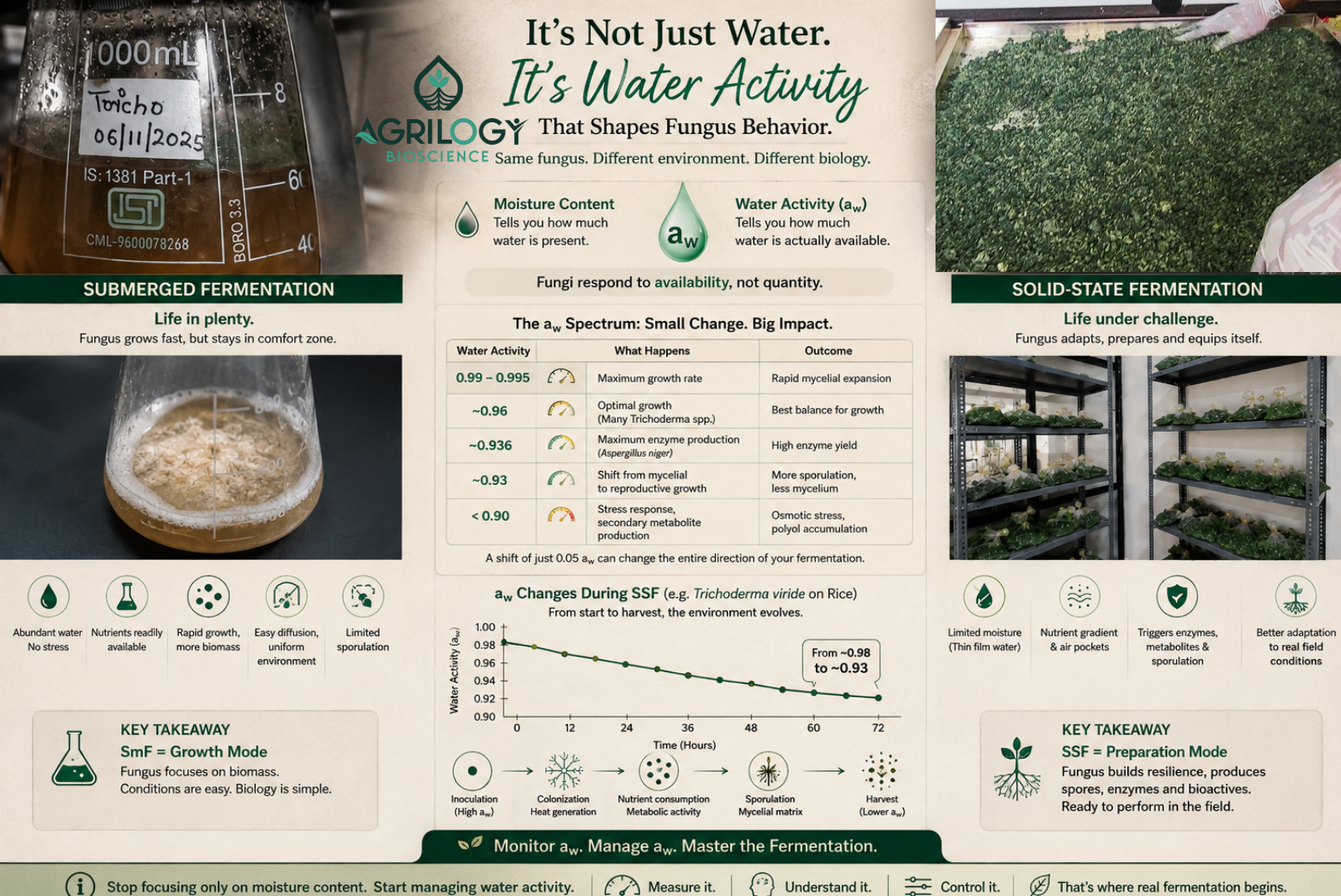
- Water Activity = 0.99 – 0.995 - Maximum growth rate, rapid mycelial expansion- Optimal growth conditions.
- Water Activity = 0.96 - Optimal growth for many Trichoderma species-Apple pomace SSF.
- Water Activity = 0.936 - Maximum enzyme production (Aspergillus niger)-Wheat bran SSF for glycoamylase.
- Water Activity = 0.93 - Dramatic shift from mycelial to reproductive growth-Increased sporulation, reduced mycelial development.
- Water Activity = Below 0.90 - Stress response, secondary metabolite production- Osmotic stress, polyol accumulation.
A shift of just 0.05 aw can change the entire direction of your fermentation.
These aren't arbitrary numbers. They represent the specific water availability that each organism—and each metabolic pathway—requires.
The Dynamic Nature of aw in SSF
Here's where it gets even more interesting—and more challenging.
Water activity isn't static during fermentation. It changes.
During SSF by Trichoderma viride on rice substrate, the trend is remarkably similar to other fungi. As the fungus colonizes, sporulates, and generates metabolic heat, the water activity steadily drops from an initial ~0.98 down to approximately 0.93 by harvest.
But here's the critical detail: the shift isn't just about the total water decreasing. The water that remains changes its physical state—transitioning from free to bound—as it gets trapped by the expanding mycelial matrix and extracellular metabolites. The water becomes progressively less accessible.
What does this mean in practice?
Even if you nail the initial moisture content, the aw will drift as the fungus grows, consumes nutrients, produces metabolites, and releases heat. The substrate's physical structure changes. Water becomes more tightly bound. The environment that was optimal at hour 0 may be suboptimal—or even inhibitory—by hour 48.
This is why monitoring aw isn't a one-time measurement. It's a continuous process that requires attention throughout the fermentation.
The Mechanism: Why Does aw Drop?
Just as with Trichoderma, the drop in aw on rice isn't just about water "drying up."
- Consumption: The fungus consumes the substrate, reducing the solid mass and altering its structure.
- Metabolic Water: Some water is consumed in metabolic reactions.
- Heat Generation: The metabolic activity generates heat. This evaporates free water and increases the substrate temperature, further lowering the relative humidity and aw.
- Binding: The fungus produces extracellular polysaccharides and other metabolites that bind to the remaining free water, making it less available.
Why This Matters for Biocontrol Production?
In my previous post, I noted that SSF produces fungi that are already "conditioned by a challenging environment before they ever reach the field". This isn't just a happy accident—it's a direct consequence of water activity dynamics.
When a fungus grows under low aw conditions, it accumulates protective compounds like polyols (mannitol, glycerol) to cope with osmotic stress. It activates stress response pathways. It produces more spores and secondary metabolites.
The result? A microorganism that is:
- More stress-tolerant when applied to the field
- More sporulated for better shelf life and formulation
- Metabolically primed to survive and compete in the soil environment
The production process doesn't just manufacture the organism. It shapes its biology.
The Bottom Line
Water content fills the substrate.
Water activity shapes the fungus.
The fungus doesn't measure moisture. It measures opportunity.
And sometimes, a few molecules of available water decide the direction of an entire fermentation.
Let's Continue the Conversation
In my previous post, I asked: "Can submerged fermentation truly replicate what solid-state fermentation naturally induces?"
Today, I want to add a second question:
How closely do you monitor water activity during SSF compared with simple moisture percentage?
Drop your thoughts in the comments. Share your experiences, your challenges, and your victories. Let's learn from each other.
This is #02 in the Fermentation Notes from the Lab series. Follow for #03, where we'll explore another overlooked principle of solid-state fermentation.
What the Green on Our Trays Is Really Telling Us
The lab has that distinct smell again. Earthy, slightly sweet, with a ghost of coconut lingering near the incubation racks. That’s 6-pentyl-α-pyrone off-gassing from our Solid-State Fermentation trays.
Monsoon is almost here. And if you look past the sales charts and the farmer helplines buzzing in the background, what we’re actually doing in this room is far more fascinating than just scaling up a biopesticide.
We are forcing a microscopic organism to make a life-or-death biochemical decision.
Walk through our production floor, and you will see the trays. Stacked high. Filled with agricultural waste—rice bran, wheat straw —all knitted together by that unmistakable green mycelial mat. Visitors usually ask about the "yield." How many spores per gram? What’s the CFU count?
I used to ask those questions too. But lately, I have started asking a different one: What exactly are we harvesting?
If you compare this to liquid fermentation, the difference is staggering.
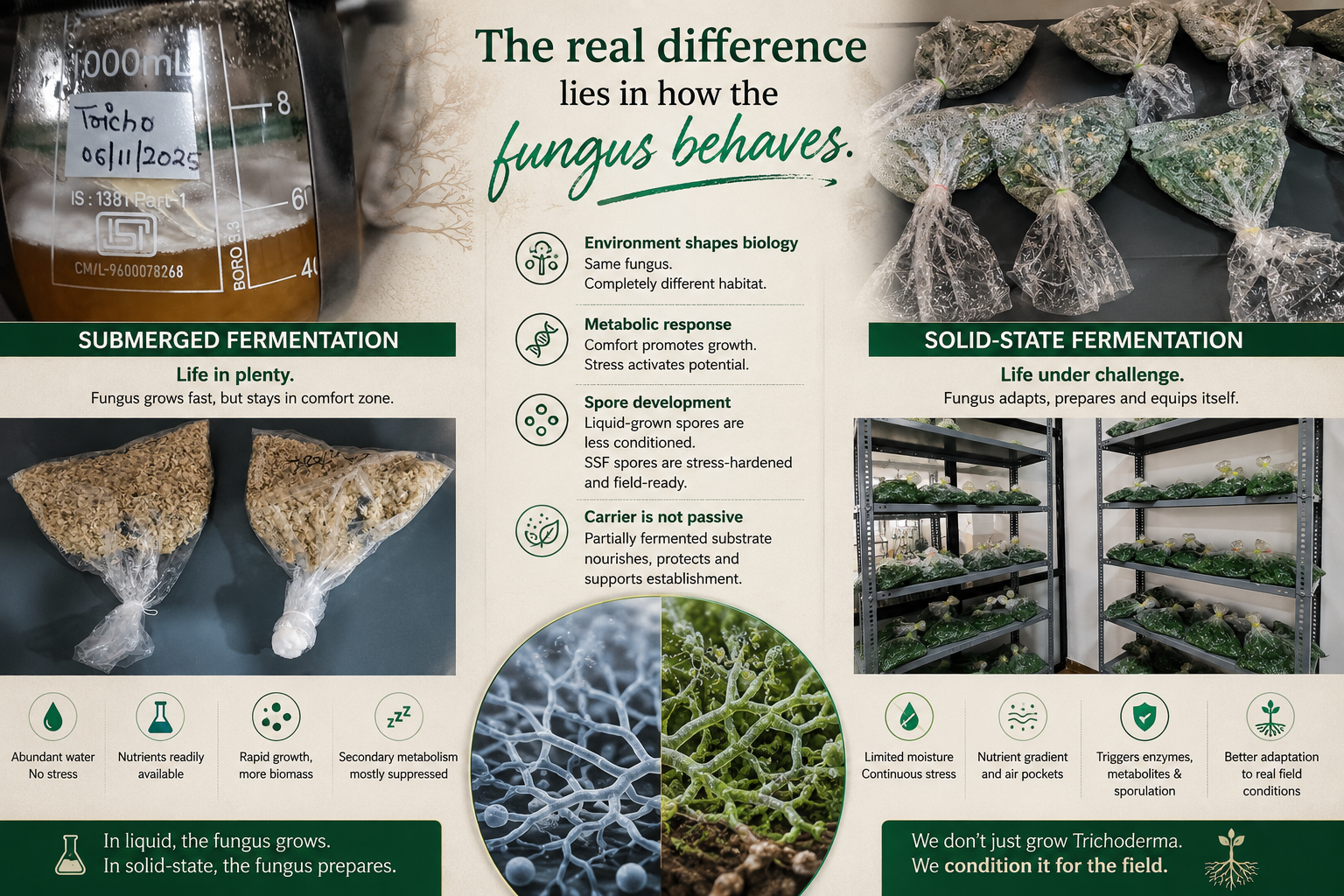
In a liquid broth, Trichoderma lives like a spoiled child. Unlimited water, abundant dissolved sugars, constant agitation. It grows fast, sure. But biochemically? It gets lazy.
The genes responsible for producing its chemical weapons—the polyketides, the peptaibols, the volatile antibiotics—mostly stay switched off. Why fire a missile when there is no war?
Solid-state fermentation flips that comfort zone upside down.
The moment we mix the substrate to that narrow sweet spot of 55-60% moisture, we create a physical paradox for the fungus. It is surrounded by solid particles, air pockets, and just enough water to survive, but not enough to thrive without effort.
The low water activity and the gradient of nutrients across the solid matrix act as a constant, low-level stress signal.
And stress, as every biochemist knows, is the greatest catalyst for secondary metabolism.
Under this subtle pressure, Trichoderma wakes up. It ramps up its non-ribosomal peptide synthetases.
It starts pumping out chitinases and glucanases, not just into a diluted liquid medium, but right into the micro-pores of the substrate where they concentrate to remarkably high local levels.
When that spore eventually lands in a waterlogged paddy field, it doesn't start from scratch. It carries those pre-formed enzymes with it, like a soldier carrying a loaded weapon to the frontline. The pathogen doesn't stand a chance.
There is another layer to this that doesn't get enough attention—the biochemistry of the spore itself.
Spores harvested from SSF trays are not the same as those washed out of a bioreactor.
Under the low-water stress of solid substrates, the fungus accumulates protective solutes like trehalose and mannitol. These are nature’s antifreeze and desiccation protectants.
Monsoon soils are brutal—they swing from saturated to dry and back again within days.
A liquid-cultured spore, with its thinner biochemical armor, often gets caught off guard. But an SSF-matured spore? It has already survived the harshest conditions of the production floor. It is biochemically primed to germinate aggressively the moment it senses root exudates.
And I haven't even mentioned the carrier yet.
We tend to think of the spent substrate as just that—spent. Inert. A vehicle to get the spores from our lab to the field. But that partially fermented agricultural waste is a biochemical time-release capsule. It is loaded with residual reducing sugars, organic acids, and even some of the very volatile organic compounds that Trichoderma uses to communicate with plant roots.
When the farmer mixes this powder with water and applies it to the soil, that carrier doesn't just dissolve away. It feeds the germinating spores, gives them a head start, and acts as a prebiotic cushion in the rhizosphere.
So, standing here with a tray in my hands, looking at the dense green sporulation, I no longer see a "mass multiplication unit." I see a miniature biochemical reactor where nature’s most sophisticated fungal agent is forced to reveal its full arsenal.
We are not growing Trichoderma here. We are negotiating with it. We provide the physical stress, the solid matrix, the imperfect environment—and in exchange, it gives us everything it has. The antibiotics. The lytic enzymes. The stress-protectants. The signaling molecules. All compressed into that green powder.
The monsoon doesn't make this product sell. The monsoon simply wakes up the biochemistry that we have already drawn out out of the fungus, weeks in advance, right there on those trays.
The question that keeps me up at night is this: Are we still evaluating our product purely by the number of green dots on a hemocytometer? Or are we finally ready to measure what actually matters—the biochemical maturity of every single spore we send out the door? Because looking at these trays, I think the fungus has already made its choice. It’s time we made ours.

Why Your Bio-Agent is Sleeping for 8 Months—And Wakes Up Only Now
Look at your warehouse shelf right now. If you are stocking Trichoderma in December or peak summer, I can almost guarantee it is gathering dust. Farmers walk past it. They don't even ask for the price.
And you know what? They are absolutely right to ignore it.
Because for eight long months, that bio-agent is essentially asleep. Useless. Just expensive powder in a bag.
But suddenly—when the clouds roll in, or when the first pre-monsoon moisture hits the soil—your phone starts ringing off the hook. Everyone wants it. Distributors are fighting over stock. Farmers are asking for it by name.
What the hell happened? Did the product suddenly become magical overnight?
No. The environment just woke it up. And if you don't understand this sleep-wake cycle, you will keep losing money for eight months every single year.
Let me explain why it sleeps
Trichoderma is a living fungus. It is not a chemical. You cannot just throw it on dry, cold, or scorching soil and expect it to fight.
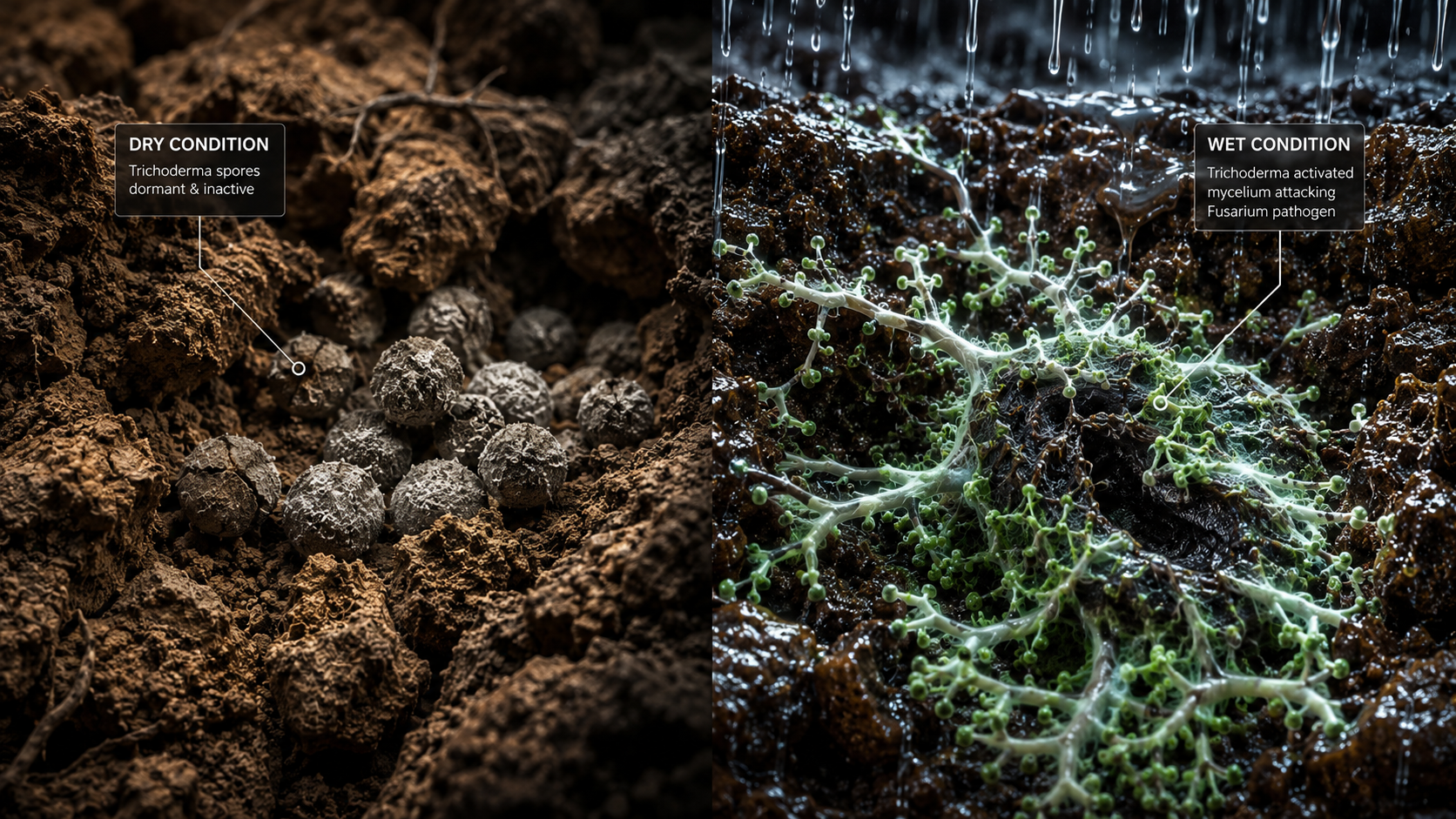
- Winter (Nov–Feb): Soil temperature drops below 18°C. The spores go into hibernation. They are alive, but they aren't multiplying or hunting pathogens. They are just... waiting.
- Summer peak (Apr–May): The ground is cracked and bone-dry. Even if you apply it, the spores have zero moisture to germinate. They lie dormant.
Farmers know this instinctively. They aren't biologists, but they know their land. They won't buy a product that can't even wake up in their field. So, for eight months, your bio-agent sleeps—and so does your sales graph.
Now, here is what finally kicks it awake
Two things need to happen simultaneously for Trichoderma to snap out of its slumber:
First, the rain or the spring thaw:
The moment soil moisture crosses a certain threshold and humidity goes above 80%, the spore senses it. It says, "Okay, conditions are safe now. Time to germinate."
Second, and more importantly—the bad guys wake up too
This is the cruel joke of nature. The same warm, wet conditions that wake up your Trichoderma are the exact same conditions that wake up the Fusarium, the Rhizoctonia, and the Pythium—the root-rotting monsters that destroy nurseries.
So, your bio-agent doesn't just wake up to stretch. It wakes up because there is a war waiting for it. And the farmer only needs it during that war. Not before. Not after.
But wait—there is another alarm clock: the sowing date
Your Trichoderma is lazy. It needs a root to cling to. It needs a seed or a young sapling to protect.
If there is no crop in the ground, the bio-agent has no food source and no purpose. That is why demand doesn't just spike with the rain—it spikes specifically in the two-week window before sowing.
Farmers think: "My seed is going in next Tuesday. I need protection right now." That is the only time they open their wallets. If you try to sell it to them a month later, after the seeds have already germinated? They will laugh at you and walk away.
And here is the ugly truth about your storage
Why does it sleep for eight months in your godown specifically? Because you are probably keeping it in a hot tin shed.
Trichoderma is fragile. Every month it sits on your shelf at 35–40°C, the spore count (CFU) drops. By the time the season actually arrives, your "fresh stock" from six months ago is half-dead.
Farmers have been burned before. They know that old stock doesn't work. That is why they refuse to buy bio-agents in the off-season, even if you offer a heavy discount. They are waiting for the fresh batch that comes straight out of the fermentation unit 60 days before the rains.
The entire supply chain runs on this panic mode—manufacturers rush production, distributors scramble for fresh lots, and retailers sell it all within six weeks. Then it goes back to sleep for another eight months.
So, what is the takeaway for you?
Stop fighting the calendar. You cannot force a living organism to work in the wrong season.
- Use the off-season to educate, not to sell. Tell your farmers: "Book your fresh stock now, I will deliver it exactly when the soil is ready."
- Check your cold storage. If you have space, keep your stock at 15–20°C to prolong its life.
- Stop discounting old inventory in the dead months. You are just devaluing your product. Instead, wait for the window—and sell it at full value when the crop actually needs it.
The bio-agent sleeps for eight months because nature designed it that way. Your job is not to wake it up early. Your job is to be fully stocked and ready the moment the rain taps on the farmer's roof.
Because when it wakes up, it wakes up angry—and ready to fight. And that is exactly when your farmer will come running to you.