

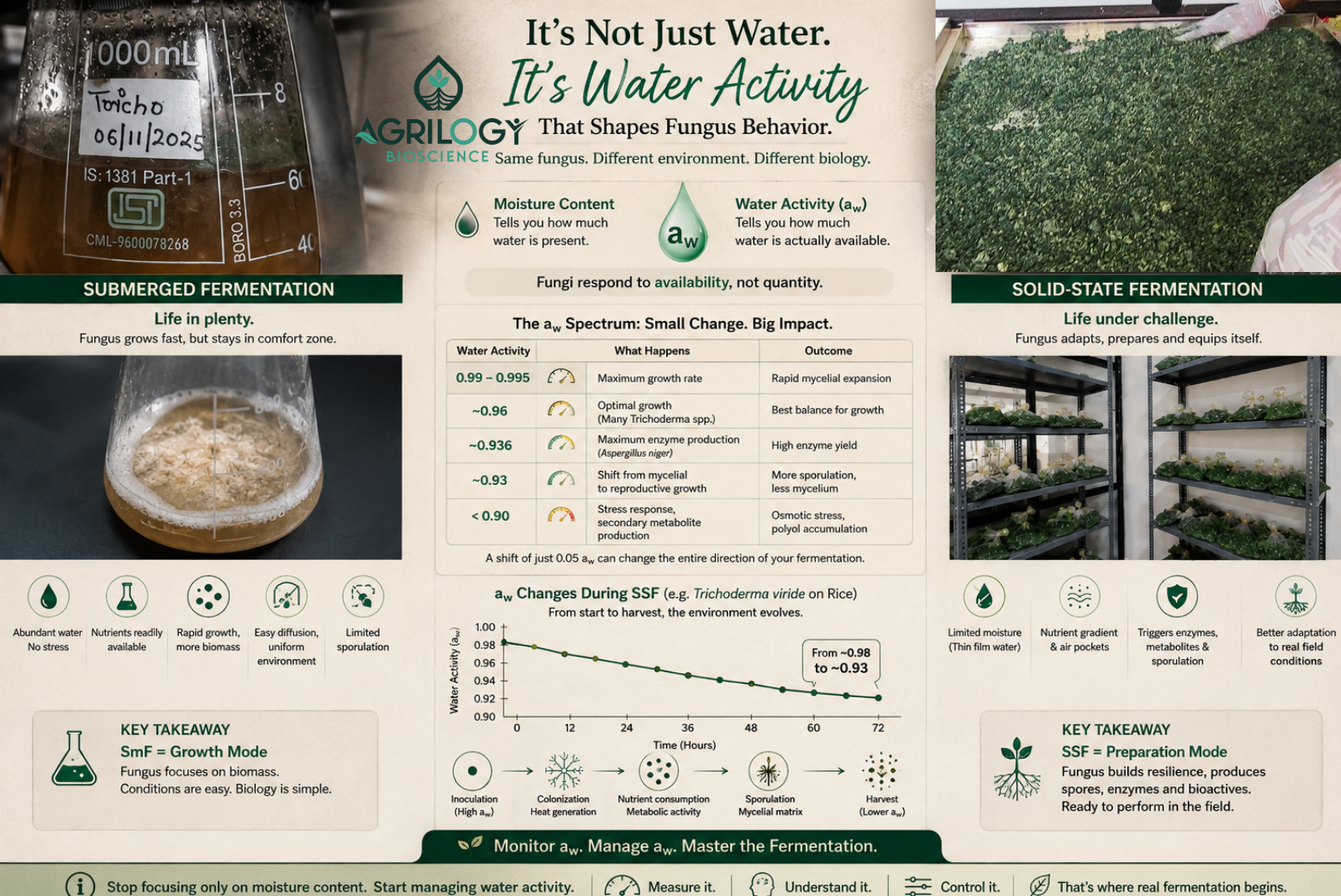
The Biology of Water Activity
This blog post continues the conversation from Solid State Fermentation vs Submerged Fermentation: Fungus Behavior. If you haven't read it yet, I recommend starting there.
The Question We Should Be Asking
In my last post, I argued that comparing Solid-State Fermentation (SSF) and Submerged Fermentation (SmF) through the lens of productivity or scalability misses the point. The real difference lies in how the fungus behaves—how it adapts, what pathways it activates, and what kind of organism it becomes.
But that raises a deeper question:
What actually drives that behavioral difference?
The answer isn't simply "less water." It's something far more fundamental—and far more misunderstood.
The Moisture Content Trap
Everyone talks about moisture content.
Very few talk about water activity.
And they're not the same thing.
Moisture content tells you how much water is present in a substrate—the total volume of water, usually expressed as a percentage of the wet weight. It's a straightforward, easy-to-measure number that has become the default metric in many fermentation labs.
But here's the problem: fungi don't respond to how much water is present. They respond to how much water is actually available.
Two substrates may contain the same percentage of water, yet one supports vigorous fungal growth while the other barely allows the fungus to survive. The effect of water activity on fungal development is highly significant, while the water content level alone does not significantly modify the fungus's development.
Why?
Because some of that water is tightly bound to the substrate particles—chemically or physically trapped—and is simply inaccessible to the microorganism. Only the "free" water, the water that isn't bound, is available for microbial metabolism, nutrient dissolution, and enzymatic activity.
That's water activity. And it's the metric that matters.
What Is Water Activity, Really?
Water activity is a thermodynamic measure of the energy status of water in a system. It's defined as the ratio of the vapor pressure of water in the substrate to the vapor pressure of pure water at the same temperature.
Pure water has an water activity of 1.00. Bone-dry materials approach 0.
Most solid-state fermentation substrates operate in the range of aw = 0.85 to 0.99, depending on the microorganism and the desired outcome.
Think of it this way:
- Moisture content tells you how much water is in the room.
- Water activity tells you how much water is on the table, ready to drink.
The fungus doesn't care about the water in the room. It cares about the water it can actually reach.
SSF: A Different World of Water
In submerged fermentation, water is abundant and continuously available. Nutrients dissolve easily, diffusion is rapid, and the fungus grows in a relatively uniform environment.
Solid-state fermentation is fundamentally different.
Water exists as a thin film around substrate particles, not as a continuous liquid phase. The fungus must continuously bridge air spaces, extend hyphae toward available moisture, and adapt to localized differences in water availability.
The result isn't simply slower growth.
It is different biology.
In SSF, the fungus faces gradients in temperature, water activity, and nutrient concentration. These gradients aren't just obstacles—they are signals that trigger specific physiological responses. The fungus alters its growth pattern, metabolism, and developmental strategy in response to the environment it experiences.
The aw Spectrum: What Different Values Mean
The relationship between water activity and fungal behavior is not linear. Small changes in aw can produce dramatically different outcomes.
- Water Activity = 0.99 – 0.995 - Maximum growth rate, rapid mycelial expansion- Optimal growth conditions.
- Water Activity = 0.96 - Optimal growth for many Trichoderma species-Apple pomace SSF.
- Water Activity = 0.936 - Maximum enzyme production (Aspergillus niger)-Wheat bran SSF for glycoamylase.
- Water Activity = 0.93 - Dramatic shift from mycelial to reproductive growth-Increased sporulation, reduced mycelial development.
- Water Activity = Below 0.90 - Stress response, secondary metabolite production- Osmotic stress, polyol accumulation.
A shift of just 0.05 aw can change the entire direction of your fermentation.
These aren't arbitrary numbers. They represent the specific water availability that each organism—and each metabolic pathway—requires.
The Dynamic Nature of aw in SSF
Here's where it gets even more interesting—and more challenging.
Water activity isn't static during fermentation. It changes.
During SSF by Trichoderma viride on rice substrate, the trend is remarkably similar to other fungi. As the fungus colonizes, sporulates, and generates metabolic heat, the water activity steadily drops from an initial ~0.98 down to approximately 0.93 by harvest.
But here's the critical detail: the shift isn't just about the total water decreasing. The water that remains changes its physical state—transitioning from free to bound—as it gets trapped by the expanding mycelial matrix and extracellular metabolites. The water becomes progressively less accessible.
What does this mean in practice?
Even if you nail the initial moisture content, the aw will drift as the fungus grows, consumes nutrients, produces metabolites, and releases heat. The substrate's physical structure changes. Water becomes more tightly bound. The environment that was optimal at hour 0 may be suboptimal—or even inhibitory—by hour 48.
This is why monitoring aw isn't a one-time measurement. It's a continuous process that requires attention throughout the fermentation.
The Mechanism: Why Does aw Drop?
Just as with Trichoderma, the drop in aw on rice isn't just about water "drying up."
- Consumption: The fungus consumes the substrate, reducing the solid mass and altering its structure.
- Metabolic Water: Some water is consumed in metabolic reactions.
- Heat Generation: The metabolic activity generates heat. This evaporates free water and increases the substrate temperature, further lowering the relative humidity and aw.
- Binding: The fungus produces extracellular polysaccharides and other metabolites that bind to the remaining free water, making it less available.
Why This Matters for Biocontrol Production?
In my previous post, I noted that SSF produces fungi that are already "conditioned by a challenging environment before they ever reach the field". This isn't just a happy accident—it's a direct consequence of water activity dynamics.
When a fungus grows under low aw conditions, it accumulates protective compounds like polyols (mannitol, glycerol) to cope with osmotic stress. It activates stress response pathways. It produces more spores and secondary metabolites.
The result? A microorganism that is:
- More stress-tolerant when applied to the field
- More sporulated for better shelf life and formulation
- Metabolically primed to survive and compete in the soil environment
The production process doesn't just manufacture the organism. It shapes its biology.
The Bottom Line
Water content fills the substrate.
Water activity shapes the fungus.
The fungus doesn't measure moisture. It measures opportunity.
And sometimes, a few molecules of available water decide the direction of an entire fermentation.
Let's Continue the Conversation
In my previous post, I asked: "Can submerged fermentation truly replicate what solid-state fermentation naturally induces?"
Today, I want to add a second question:
How closely do you monitor water activity during SSF compared with simple moisture percentage?
Drop your thoughts in the comments. Share your experiences, your challenges, and your victories. Let's learn from each other.
This is #02 in the Fermentation Notes from the Lab series. Follow for #03, where we'll explore another overlooked principle of solid-state fermentation.