
- Home
- VAM Culture Collapse: Why Spore Density Drops After Many Subculture Cycles (And How to Fix It)

Aditi Bijalwan
Co-founder at Agrilogy Bioscience Private Limited
Unequal inoculum division caused a VAM culture to lose spore density and hyphal integrity by the 3rd subculture. Learn the scientific reasons behind VAM collapse and proven cures like trap culture revival.
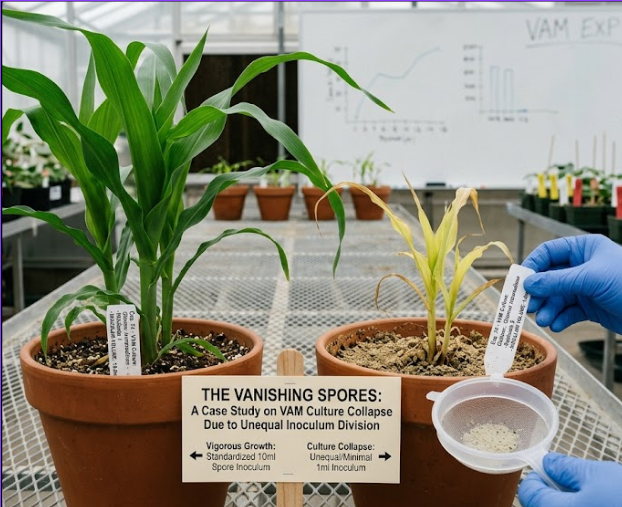
A commercial biofertilizer producer recently reported a troubling pattern. Their VAM (arbuscular mycorrhizal) culture bottles initially showed excellent growth: dense roots, abundant hyphae, and high spore density both in the gel and within root tissues.
But after production pressure led them to divide a single mother culture unequally into 20 parts, something went wrong. By the 3rd subculture cycle, spore density dropped to negligible levels. Long hyphae were replaced by broken hyphal fragments. Eventually, bottles contained no viable spores at all.
This case study explains why VAM cultures collapse under low inoculum density, how to revive them, and most importantly — how to prevent it.
Why Does VAM Culture Collapse Happen? (Scientific Causes)
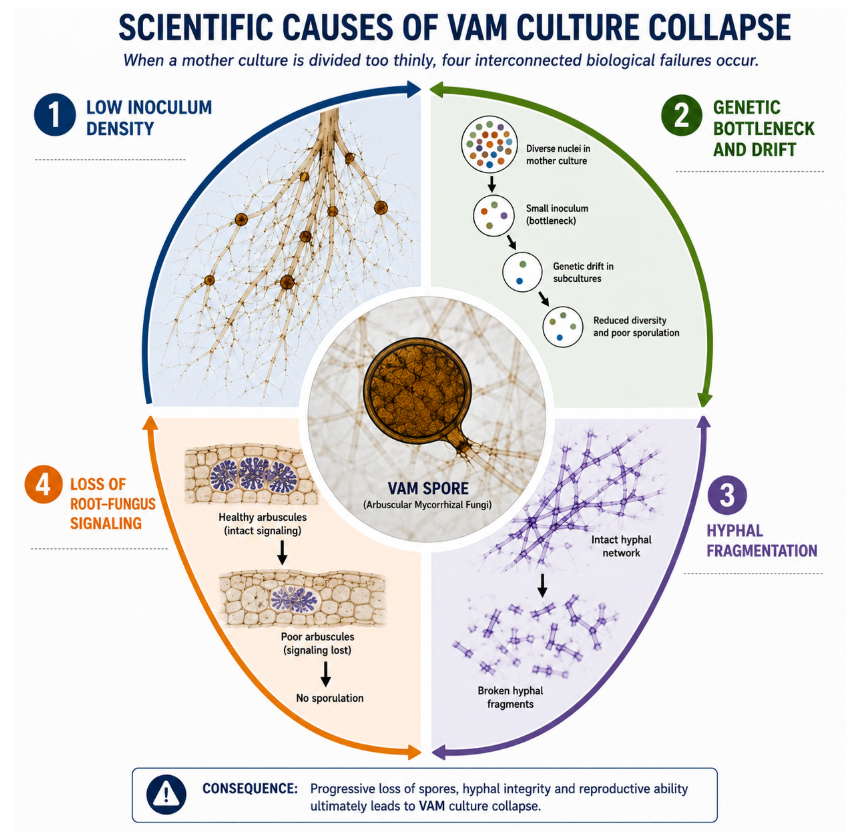
When a VAM mother culture is divided too thinly, four interconnected biological failures occur.
1. Low Inoculum Density – The Primary Culprit
VAM fungi are obligate biotrophs – they cannot grow without a living root. Each new subculture requires a minimum threshold of propagules (spores, hyphae, colonized root fragments) per bottle.
Dividing one bottle into 20 parts means most new bottles receive a sub‑critical inoculum density. With too few starting propagules:
- Root colonization is slow and patchy.
- The hyphal network never reaches sufficient density.
- Sporulation signals are never activated.
Scientific evidence: Multiple studies confirm that low initial inoculum density reduces infectivity and spore output, often causing complete collapse by the 3rd or 4th generation.
2. Genetic Bottleneck and Drift
VAM hyphae are coenocytic – thousands of genetically distinct nuclei share the same cytoplasm. This diversity is essential for reproductive fitness.
Taking a small, arbitrary slice of the mother culture creates a genetic bottleneck. Only a fraction of the original nuclei survive. With each subsequent subculture cycle, additional random loss occurs (genetic drift). The culture may still grow hyphae but loses the ability to form spores.
3. Broken Hyphal Fragments – A Sign of Senescence
Each subculture requires cutting the gel and roots. For coenocytic VAM, this produces broken hyphal fragments with disrupted nuclear distribution. Unlike many molds, VAM fragments do not regenerate into a functional network. Repeated fragmentation leads to senescence – the culture becomes a collection of dying pieces.
4. Loss of Root‑Fungus Signaling
Spore formation depends on continuous signaling between healthy arbuscules and hyphae. When spore density falls below a threshold, arbuscules fail to develop properly. The signal cascade never starts. The fungus stops reproducing and eventually dies.
The Cure: How to Revive a Collapsed VAM Culture
Once you see only broken hyphal fragments and no spores, direct subculture into fresh media will fail. Use one of these validated methods.
Method 1: Trap Culture Revival (Most Reliable)
VAM cannot be grown axenically. To revive a senescent culture, pass it through a living host.
- Mix the failed bottle contents (roots + gel) with sterile soil or sand.
- Plant a highly mycotrophic host – sorghum, sudangrass, or maize.
- Grow for 90–120 days under low‑phosphorus conditions.
- Harvest roots and rhizospheric soil. These contain a fresh, vigorous population of spores and hyphae.
Trap culture allows the fungus to reset its genetic diversity and eliminate weak fragments.
Method 2: Sheared‑Root Inoculum for Rapid Production
If you need immediate revival:
- Take healthy colonized roots (from a trap culture or known vigorous mother stock).
- Blend gently in sterile water (short pulses).
- Centrifuge and resuspend to a standardized density (e.g., 1000–2000 propagules per mL).
- Use this liquid inoculum to start new bottles.
This provides a dense, even suspension that bypasses fragmentation problems.
Prevention: 5 SOPs to Avoid VAM Culture Collapse
Production pressure is real, but these scientifically validated precautions will keep your VAM cultures healthy for many generations.
1. Standardize Inoculum Density
Calibrated Scoop (No Blending, No Weighing)
- Calibrate once: Take a sterile scoop (1–2 cm³). Scoop 10 samples into pre‑weighed tubes. Weigh outside LAF. If variability <20%, the scoop is ready.
- In production: Take one level scoop from the mother culture and transfer into each new bottle. Repeat for all bottles. Keep scoop in ethanol between uses.
- No balance inside LAF – fast, practical for 500+ bottles.
Quality Check: Sample 3 bottles per batch (0.6% of 500). Check propagule density under microscope. Target: 1,000–5,000 propagules per bottle
2. Enforce a 3‑Generation Limit
Do not subculture any VAM line more than three times from the original master stock. After the second subculture, return to a master stock (cryopreserved or dried spores).
3. Maintain a Master Seed Bank
- Store dried spores mixed with sterile sand in airtight containers at 4°C.
- Revive a fresh master culture every 3–6 months for production.
4. Rotate Host Plants
Repeated subculture on the same plant selects for host‑specific strains. Rotate between:
- C3 plants (onion, clover) and C4 plants (sorghum, maize).
- This preserves functional diversity and sporulation capacity.
5. Monitor Hyphal Integrity
Before each subculture, examine a sample under a dissecting microscope. If more than 30% of hyphae are broken fragments (not intact networks), do not use that bottle. Revive via trap culture first.
FAQ: Common Questions About VAM Culture Collapse
Q: At what subculture cycle does VAM collapse typically happen?
A: In this case study, collapse became evident by the 3rd subculture cycle. Studies show that low inoculum density often causes failure between the 3rd and 4th generation.
Q: Can I directly subculture broken hyphal fragments into fresh media?
A: No. VAM fragments do not regenerate well. Always use trap culture revival before attempting new production bottles.
Q: How do I measure inoculum density without expensive equipment?
A: Use a most probable number (MPN) assay with a host plant. It requires only pots, soil, and a greenhouse – no molecular tools needed.
Q: What is the ideal inoculum density for VAM subculture?
A: Based on published research, 1,000–5,000 propagules per bottle (or per 100 mL gel) is recommended. Lower than 500 propagules significantly increases collapse risk.
Q: Can I store master VAM cultures long‑term?
A: Yes. Air‑dried spores mixed with sterile sand and stored at 4°C remain viable for 1–2 years. Revive every 6 months for best results.
Conclusion: Respect the Biology of VAM
This case study shows that unequal, low‑density inoculum division is a direct path to VAM culture collapse. The scientific causes – sub‑critical inoculum density, genetic drift, hyphal fragmentation, and signaling failure – are well understood and entirely preventable.
The cure is trap culture revival. The prevention is standardized inoculum density, generation limits, and routine monitoring.
Have you experienced a sudden drop in spore density or seen broken hyphal fragments in your VAM bottles? Share your experience in the comments.
Comments (0)
No comments yet. Be the first to comment!
Search Blogs
Recent Blogs

The Biology of Water Activity
August 7, 2026
What the Green on Our Trays Is Really Telling Us
July 29, 2026
Leave a Comment